


SKIING ZARLENGO
moose tracks bewitching the breath
black squirrel daggled with powder
no lodgepole but this tree this bough
too many to read but one is enough
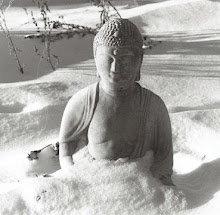


 "Life always gives us exactly the teacher we need at every moment. This includes every mosquito, every misfortune, every red light, every traffic jam, every obnoxious supervisor (or employee), every illness, every loss, every moment of joy or depression, every addiction, every piece of garbage, every breath. Every moment is the Guru." --Charlotte Joko Beck
 Here's a whimsical little interactive piece on Zen from Japan. Be prepared to click on an image to advance the narrative.
 Because cross-country skiing exists, there is non-cross-country skiing. Because poetry exists, there is non-poetry. Because breathing in exists, there is breathing out. Because hatred exists, there is compassion. Because greed exists, there is generosity. Because birth exists, there is the unborn. Because death exists, there is no-death. Because the self exists, there is no-self.
  Deep winter nights definitely encourage and evoke inwardness and stillness—a chance to stop and reflect on what's vital. In deep zazen we devour the breath and the breath devours us. There's no separation. The barking of the neighborhood dog devours us. The sound of traffic replaces us. The cell phone in the other room rings in the center of the mind.
  There's something inherently daunting about trying to describe or talk about the Dharma or Zen or just the practice of sitting. Words can't reach it and the Zen adepts of old would often respond or teach non-conceptually by remaining silent, shouting, drawing an enso like the one above, or even hitting disciples who asked questions like: What is Zen? What's the teaching of the Buddha? What's the point of practice? Who am I? But sometimes it's necessary to say something and it's not just zen masters who get asked about it.
 Henry David Thoreau famously believed that the vast majority of people "lead lives of quiet desperation." Imagine Thoreau saying this today on Larry King Live or on Oprah!. I think he'd probably sound like some condescending dean or like he was getting ready to introduce the Thoreau Personal Empowerment Plan. But surely most people feel at some point that something profound is missing from their lives—a personal, direct connection to something sacred and eternal. It may be just a vague yet deep dissatisfaction, regardless of material wealth, success, fame, etc., a kind of gnawing discontent with things as they are. In any case, I don't think our culture really knows how to deal with this rich, existential aspect of being human--sometimes called the dark night of the soul at its most intense--other than providing ways to avoid it, numb it, or explain it away. This is of course prima materia for the arts and for most spiritual paths. I remember telling my Zen teacher early in my training that the universe was meaningless and I had no idea what to do with my life. He said, very sincerely, "Excellent. Now you can use that to really dig in and practice."
_3.jpg) If past and future are private/social constructs and the present is ungraspable, how do we understand time? It's so easy to think of time as passing us by or passing quickly but aren't we right here in the river with it, as it?
If past and future are private/social constructs and the present is ungraspable, how do we understand time? It's so easy to think of time as passing us by or passing quickly but aren't we right here in the river with it, as it?
 In 2008 the Denver Zen Center dedicated the June sesshin to John Daido Roshi who had just started aggressive chemotherapy for lung cancer. I happened to be jisha and so called Zen Mountain Monastery to let them know of the dedication. Daido's assistant said that earlier in the day he had joked about people not realizing that the cure was killing him, not the cancer. I never had the privilege of meeting him, but I wasn't surprised to hear that he hadn't lost his sense of humor.
  There's a single frame in a Robert Crumb comic strip (I'll replace Mr. Natural here with it, if and when I find it) with a close-up of a typically bugged-out Crumb character who seems shocked and panicky—sweating profusely, eyes popping—saying, "I...I just realized. Everything is cosmic!" Yes! There's no place more cosmic than right where you are, no activity more cosmic than what you do each moment. How could there be? There's no place more enlightened than this place, no moment more enlightened than this moment, no Buddha more enlightened than this very person. Each one of us is, dude, way cosmic. We are fundamentally without bounds, without definition, ungraspable, birthless, deathless. Walt Whitman said: "I am vast. I contain multitudes." The only question is: to what degree do we realize it? Can we drop the fabricated "I" who thinks I'm in here and everything else is out there?
 Herman Hesse's novella Knulp is a great tale about the wisdom of not-knowing and our obligation to trust and rest in that vast space. It's a story about a man named Knulp (spoiler alert!) who spends his life wandering from town to town, from relationship to relationship, from job to job, never committing, never tying himself to anything or anyone. He's sort of monk-like but without any intentional matrix of practice. At the end of the story we find him dying in a snowstorm, believing that he's wasted his life. But he has a moment of clarity, a vision of God who says, "I wanted you the way you are and no different. You were a wanderer in my name and wherever you went you brought a little homesickness for freedom." What's so great about this story for me isn't that there's some secret significance or mission we each have but simply that each one of us belongs here in a very deep, undeniable way. Despite what we may sometimes believe or despite what other people or some cultural norm or government may say. Not only do we belong but we ourselves are intimately woven into the heart of the mystery of the world. If we look deeply enough we see that our lives and this mystery itself are not separate—even if we can't articulate why we're alive or what we're doing here. And even if we can articulate the whys and the whats of our life, surely it's an incomplete grasp. Surely, the most profound meaning of our lives lies far beyond words and worldly understanding. When replying to the question Who is this speaking to me? put to him by Emperor Wu, Bodhidharma famously said, "I do not know."


